

Credit: UNU-INRA
Piloting of Youth-Designed Clean Technologies for Women Farmers in Ghana and Senegal
19 September 2025
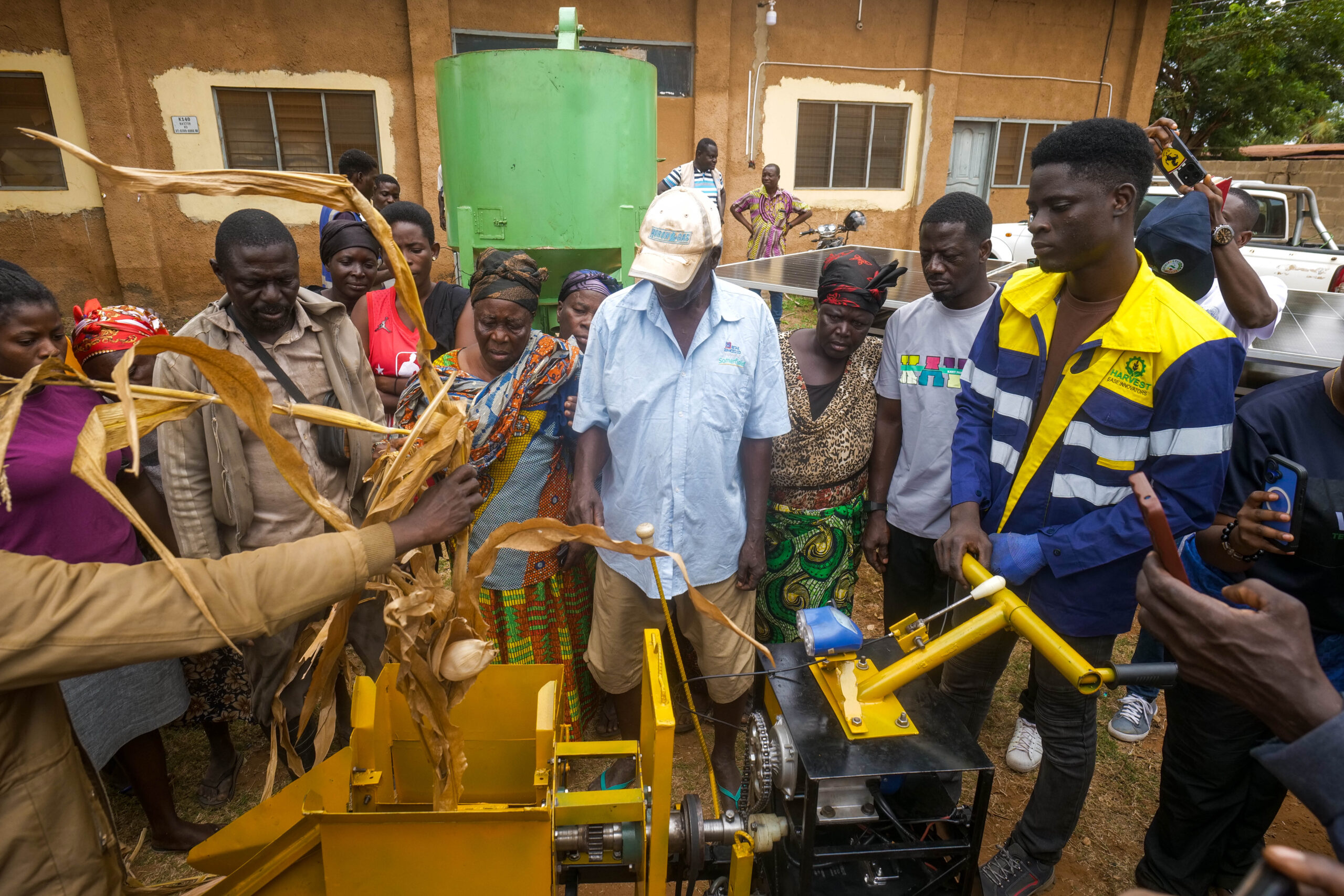
Recently, the Innovate for Clean Powered Agro Technologies (INFoCAT) project held two events in Ghana and Senegal, to showcase and pilot clean technology solutions that have been developed by young Agritech Innovators. Each new technology was developed to address challenges faced by smallholder women farmers and agro-processors.
Credit: UNU-INRA
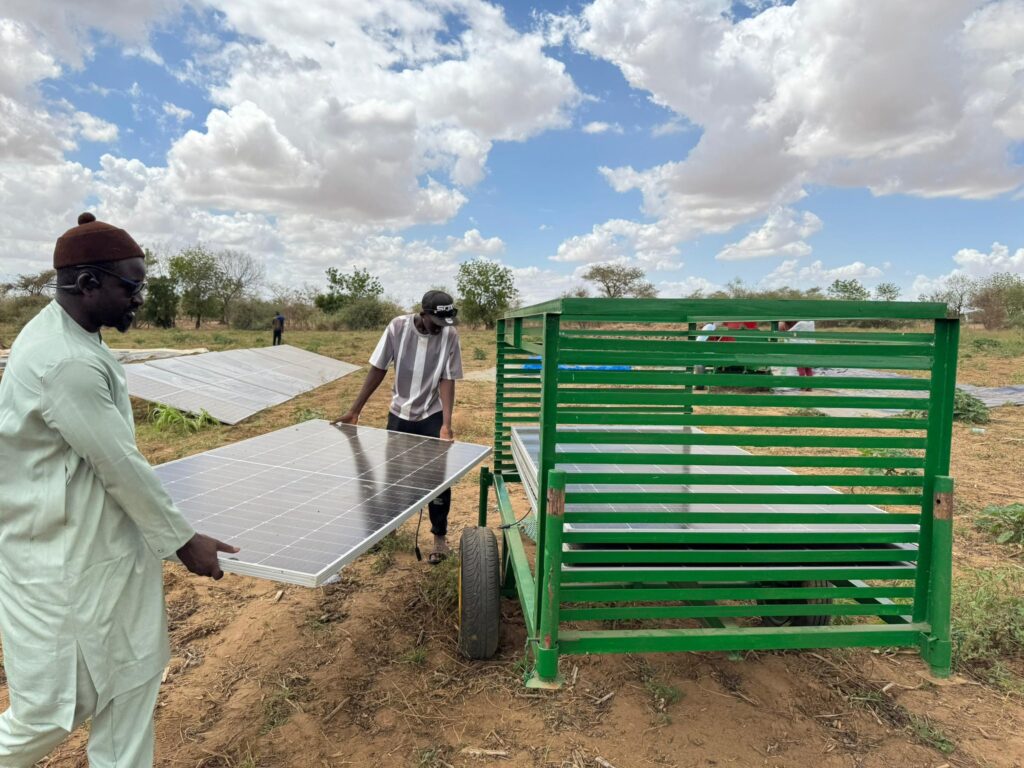
The piloting programme was to show the creativity and problem-solving capabilities of young green innovators who have designed context-appropriate clean technologies to enhance agricultural productivity, expand access to clean energy, reduce drudgery, and promote climate resilience among smallholder farmers and post-harvest crop processors. The machines are powered by clean energy.
During the programme
- The innovators presented to test-run, and demonstrated how the technologies function.
- Smallholder women farmers were trained on the effective operation of the technologies.
- Key stakeholders engaged in discussions on fine-tuning, scalability, sustainability, and adoption pathways.
Innovations from Ghana
From 26th to 29th August 2025, the innovations developed by young Agritech innovators were piloted in Namesi -Yilo Krobo District of Ghana’s Eastern Region, Aveyime in the North Tongu District of Volta Region, Gomoa East District in the Central Region.
Credit: UNU-INRA
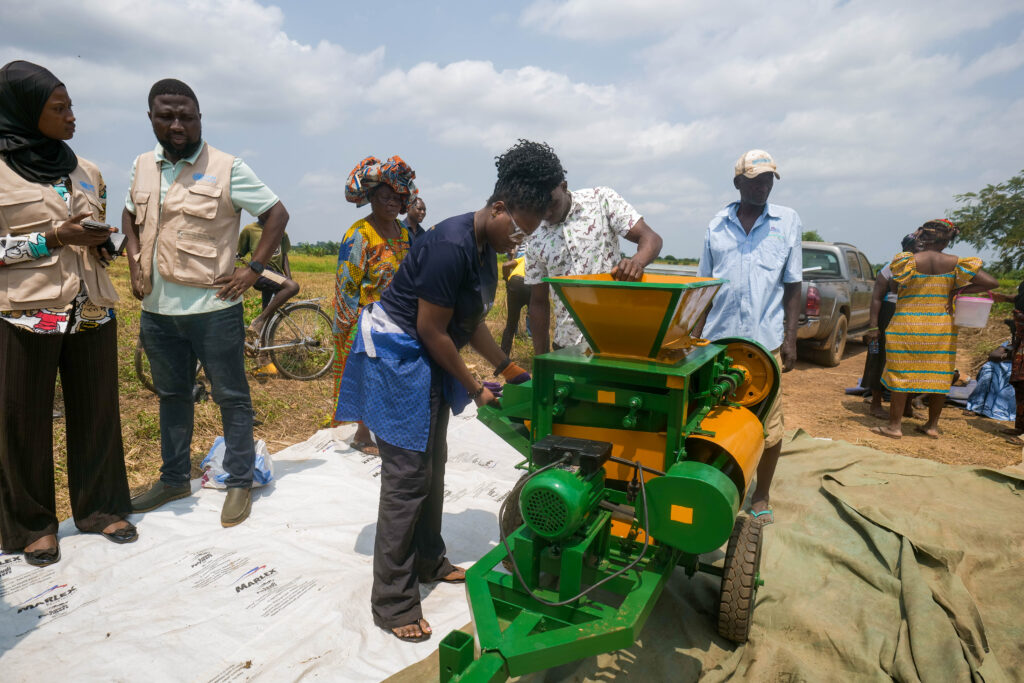
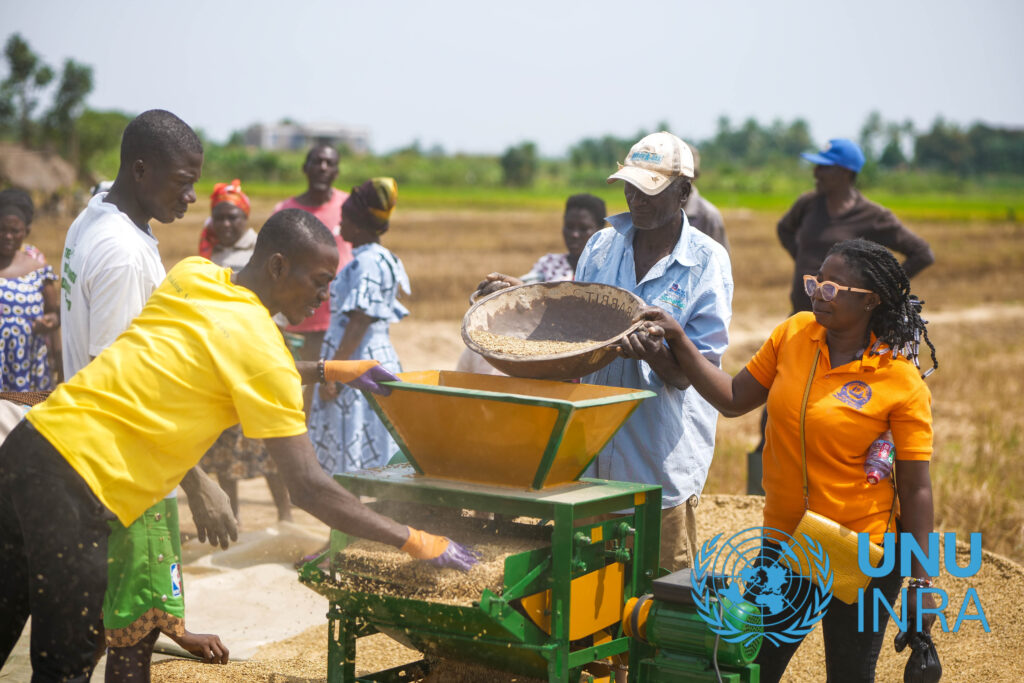
Innovations piloted in Ghana included
- Integrated Cassava Processing Unit: A Cassava peeling and washing machine, a cassava grater, an energy efficient multi-fuel (LPG/biogas, briquette, charcoal, firewood) gari (cassava flakes) roaster and a biogas system that produce biogas, stores and utilises it to power a biogas generator that supplies electricity to the facility (where this unit is kept). The waste from the cassava processing serves as the feedstock for the biogas generation.
- Solar-battery-powered grains dryer
- Solar-powered rice winnower
- Smart solar powered irrigation system
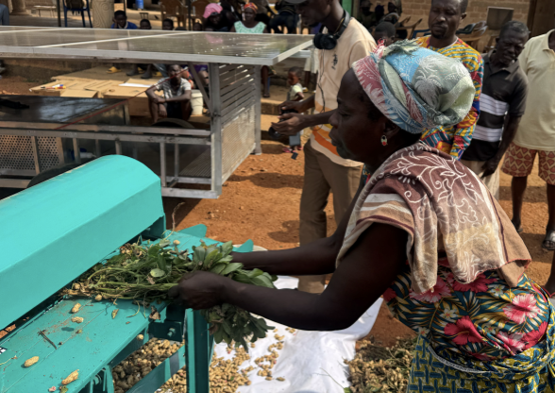
- Groundnut plucking machine
- Mini Combine harvester to harvest and de-husk maize.
Innovations from Senegal
Om 17th and 18th July, innovations were also piloted in Senegal’s Bambèye (Diourbel region), Toubacouta (Fatick region), Taïba Niassène (Kaolack region), and Gapakh (Kaolack region).
Innovations piloted in Senegal include:
- A Groundnut pod plucker and dehuller
- A mobile solar powered cool house for preservation of harvested food crop
- A cashew nut crusher
- A smart solar-powered irrigation system
- A dynamo- energy generator
Cote D’Ivoire will be subsequently piloting their clean agritech innovations in the coming months.
Credit: UNU-INRA
Background
Prior to this piloting stage, innovators (10 in Ghana, 5 in Senegal and 5 in Cote D’Ivoire), who were shortlisted as part of the INFoCAT Innovation Challenge, won an initial grant of $7,400. Subsequently, they went through a series of meetings with smallholders and industry experts to fine-tune their initial agritech innovations to make them more efficient for farmers and agro-processors. A key element of these innovations is also the renewable energy component. Agricultural and renewable energy experts have coached these young innovators throughout the process of fine tuning these machinery, to make them more environmentally friendly.
After this piloting stage and rigorous appraisal of the innovations, 3 of these innovators (1 from Ghana, 1 from Senegal and 1 from Cote D’Ivoire) will be selected. These winners will receive a sum of $37,00 to scale up their innovations/businesses.
About INFoCAT
UNU-INRA’s INFOCAT (Innovate for Clean Agricultural Technologies) is an initiative funded by International Development Research Center (IDRC) under the Clean Energy for Development: A Call for Action initiative (CEDCA). INFoCAT implemented in Ghana, Senegal, and Cote d’Ivoire. Project Partners are Enda Energie (Senegal) and UNU-INRA operating Unit (Cote D’Ivoire).
The overall goal of the project is to advance women’s and youth economic empowerment in rural areas of selected African countries by promoting low-cost, clean, energy-powered technology solutions that increase agricultural productivity and income for smallholder rural farmers.
- The INFoCAT Project was started to address these dire issues in the agricultural sector:
- Inadequate opportunities for green entrepreneurship and innovation.
- High levels of drudgery in smallholder farming communities.
- Health associated risks with the use fossil-fuel powered agritech machinery,
- Unfavourable policy environment (for women-led micro, small and medium-sized enterprises (MSMEs) hindering effective market competition.
- Limited access by young innovators to finance to move clean agritech solutions from prototype to market level.
- Limited opportunities for skills development, mentorship and networking; and underrepresentation of youth and women in decision-making roles in the clean technology sector.
blog
Theme
Gender and Agriculture
Lead Partner
UNU-INRA
The United Nations University Institute for Natural Resources in Africa (UNU-INRA) aims to bridge the gap between science and natural resources management policies in Africa. UNU-INRA’s mandate is to contribute to the sustainable development of Africa’s natural resources in a way that maintains the quality of the natural environment and transforms lives.
Read moreAssociated Project
Innovate for Clean Powered Agro Technologies
Smallholder farmer testing INFoCAT renewable energy powered groundnut pod plucker in Gomoa (Central Region, Ghana). Photo by UNU INRA.
Webinar: Clean Energy Transitions: A care economy lens
Wednesday 16 September 2026
Clean energy transitions: what changes when we put care at the centre? Join us for an engaging webinar exploring how clean energy transitions can do more than expand access to power: they can also reduce drudgery, shift how unpaid care work is recognised and shared, and open up new opportunities for women and young people in […]
Solar panels, Bolivia
Inclusive and Clean Energy for SMEs in Rural Bolivia
7 October 2026
Bolivia has achieved high rates of electricity access, yet rural and semi-rural producers still face major barriers to securing reliable, affordable energy for productive use. Small- and medium-sized enterprises (SMEs) in the agrifood sector play a central role in ensuring national food security and creating employment. However, they remain highly dependent on fossil-fuel-powered pumps with […]
Smallholder farmer testing INFoCAT renewable energy powered groundnut pod plucker in Gomoa (Central Region, Ghana). Photo by UNU INRA.
Putting care at the centre of clean energy transitions
14 October 2026
Clean energy transitions are often discussed in terms of technology, finance and climate targets. But what changes when we put care at the centre? Across many low- and middle-income countries, women and girls carry a disproportionate share of unpaid care and domestic work. Cooking, collecting fuel and water, caring for others, processing food, and sustaining […]