

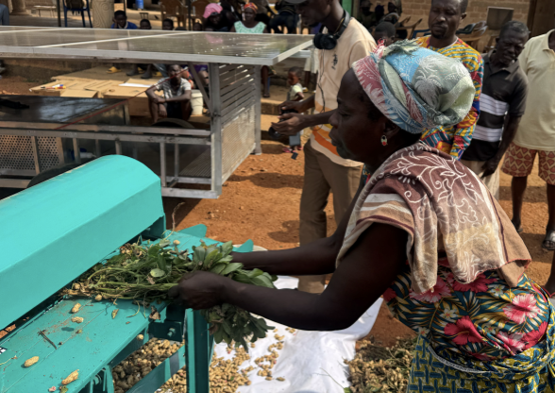
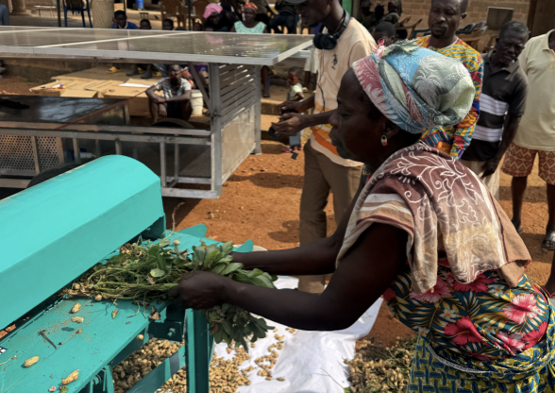
Smallholder farmer testing INFoCAT renewable energy powered groundnut pod plucker in Gomoa (Central Region, Ghana). Photo by UNU INRA.
Putting care at the centre of clean energy transitions
14 October 2026
Clean energy transitions are often discussed in terms of technology, finance and climate targets. But what changes when we put care at the centre?
Across many low- and middle-income countries, women and girls carry a disproportionate share of unpaid care and domestic work. Cooking, collecting fuel and water, caring for others, processing food, and sustaining household livelihoods are all closely tied to energy access. When energy is unreliable, costly, or difficult to obtain, these tasks take longer, demand more physical effort, and leave less time for rest, learning, paid work, or public participation.
Clean energy technologies can ease these burdens. Solar irrigation, renewable-powered agro-processing equipment, decentralised energy systems, and cleaner cooking solutions can reduce the time and physical strain associated with essential work. Yet saving time is not the same as transforming gender relations.
A recent webinar brought together researchers and practitioners to examine how clean energy can do more than expand access to power: it can reduce drudgery, reshape unpaid care work, and open up new opportunities for women.
The discussion drew on the report Clean Energy Transitions: A Care Economy Lens, which brings together evidence from West Africa, Vietnam, Burkina Faso, Uganda, and Kenya. Its central finding is that transitions become genuinely transformative only when they address unequal power relations, access to finance, control over assets and income, and the unequal distribution of care.
What the webinar highlighted
1. Energy poverty translates directly into time poverty
Evidence from rural contexts shows that energy systems are not gender neutral. Women frequently sit at the intersection of energy poverty, agricultural labour, and unpaid care. Manual irrigation, unreliable energy, and the need to collect water or fuel extend their working days and increase physical strain.
Solar irrigation and similar labour-saving tools can reduce this burden, but awareness alone does not drive uptake. Women also need affordable finance, particularly where they lack collateral, asset ownership, or access to suitable credit.
2. Time saved must translate into agency, not just more work
Clean energy can free up time, but wider gender norms determine who benefits. Time saved may simply be absorbed into more productive or unpaid work. Energy access therefore matters, but agency determines whether time savings improve rights and wellbeing. Programmes need to ask who owns and controls the technology, who decides how income is used, who benefits from greater productivity, and whether care is shared more fairly.
3. Women must be involved in designing and owning clean technologies
Women farmers and processors often complete highly labour-intensive tasks manually, from irrigating fields to processing cassava, grains, and groundnuts. Renewable-powered technologies such as solar dryers, grain winnowers, and cassava processing equipment can significantly reduce this labour. To be effective, however, technologies must be designed around women’s lived realities, including affordability, accessibility, ease of use, and proximity.
Women are too often involved only as end users rather than as designers, innovators, and owners. Supporting their participation in clean technology requires access to capital, green finance literacy, mentoring, and networks connecting entrepreneurs, policymakers, researchers, and the private sector. It also means involving women early enough for their needs to shape the technology itself.
4. A gender-just transition needs an enabling ecosystem
Collateral-free credit, pay-as-you-go models, grants, accessible energy hubs, and capacity strengthening can help women benefit from clean technologies. Policies also need care indicators and better time-use data, so success is measured through changes in workload, wellbeing, agency, and opportunity – not simply the number of technologies deployed.
Why care must be central to clean energy policy
The webinar’s message was clear: a just energy transition cannot be judged only by megawatts generated or technologies deployed. It must also be judged by whether it reduces everyday burdens, expands women’s choices, and supports a fairer distribution of care. The 3Rs framework offers a practical guide: recognise unpaid care as real and valuable work; reduce its time and physical burden; and redistribute responsibility more fairly between women and men, households, communities, and public services.
Read the report
To explore the evidence and practical recommendations in more depth, read Clean Energy Transitions: A Care Economy Lens. The report shows why care must be built into the design, financing, and evaluation of clean energy transitions if they are to deliver meaningful gains in equality and wellbeing.
blog
Theme
care economy; just transitions
Smallholder farmer testing INFoCAT renewable energy powered groundnut pod plucker in Gomoa (Central Region, Ghana). Photo by UNU INRA.
Webinar: Clean Energy Transitions: A care economy lens
Wednesday 16 September 2026
Clean energy transitions: what changes when we put care at the centre? Join us for an engaging webinar exploring how clean energy transitions can do more than expand access to power: they can also reduce drudgery, shift how unpaid care work is recognised and shared, and open up new opportunities for women and young people in […]
Smallholder farmer testing INFoCAT renewable energy powered groundnut pod plucker in Gomoa (Central Region, Ghana). Photo by UNU INRA.
Clean Energy Transitions: A Care Economy Lens
20 April 2026
How can clean energy transitions reduce energy poverty while also addressing the unequal burden of unpaid care work? This is an increasingly urgent question as the global shift to clean energy reshapes not only energy systems, but everyday life within households. Across many low- and middle-income countries, women and girls continue to shoulder a disproportionate […]
Smallholder farmer testing INFoCAT renewable energy powered groundnut pod plucker in Gomoa (Central Region, Ghana). Photo by UNU INRA.
Putting care at the centre of clean energy transitions
14 October 2026
Clean energy transitions are often discussed in terms of technology, finance and climate targets. But what changes when we put care at the centre? Across many low- and middle-income countries, women and girls carry a disproportionate share of unpaid care and domestic work. Cooking, collecting fuel and water, caring for others, processing food, and sustaining […]