

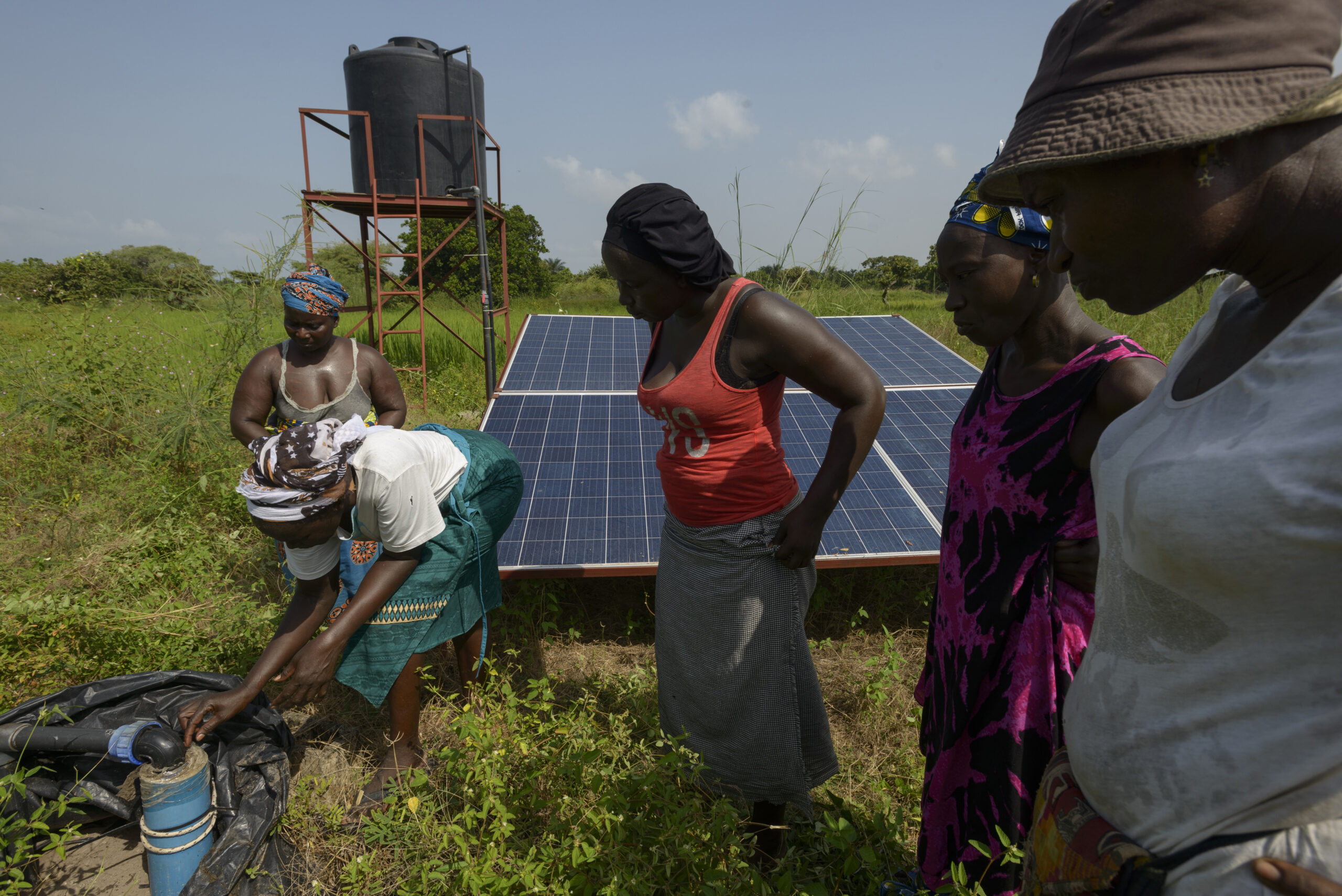
Women working in their fields in GIE Kaout, a women- led agricultural cooperative in Senegal. The group of 32 women grow rice in order to develop the cultivation of other produce such as fruits and vegetables. Their plot is fenced and has a water tower with solar panels to run the pump. Credit: © JB Russell/Panos Pictures
Beyond COP31: putting people at the heart of the clean energy transition
19 November 2026
As COP31 draws to a close, new evidence from across 27 countries shows that the biggest barriers to an inclusive clean energy transition are often not technological, but financial, institutional and social.
As attention shifts from negotiation to delivery, a new research synthesis report ‘From Clean Energy Transition to Just Energy Futures’ offers a practical answer to a difficult question: How do clean energy ambitions become change that people can feel?
The report is published by the Clean Energy for Development: Knowledge Translation and Communications Support programme, led by IDS. It draws on 189 outputs from projects providing lessons and recommendations for policy and practice, identifying four key findings:
1. Start with livelihoods, not technology
The answer is to start with how people make a living. Clean energy gains traction when it raises productivity, incomes and resilience, not simply when it becomes available. Evidence from Bhutan, Bolivia, Burkina Faso, Ghana, Kenya, Senegal, Uganda and Vietnam shows that people take up clean energy when it improves their farming, businesses and incomes. In Bhutan, farmers became much more interested in solar irrigation pumps once proof-of-concept projects showed the savings and productivity gains compared with diesel pumps. In Bolivia, fish farmers were more likely to adopt solar-powered oxygen generators over gasoline pumps after visiting pilot projects and seeing the cost savings first-hand.
2. Turn policy ambition into implementation
Strong policy support was not enough on its own. Fragmented responsibilities across energy, agriculture and water institutions slowed implementation in Bhutan. The project responded by developing planning tools and strengthening coordination between agencies, helping bring productive uses of renewable energy into the country’s National Energy Policy 2025.
3. Finance alone isn’t enough
Finance matters, but it is rarely enough. In Vietnam, fewer than half of surveyed farmers were willing to adopt solar water pumps even when preferential loans were available. The guide finds that affordable capital works best when paired with knowledge, confidence, mentoring and market access. Local businesses often provide the missing link, installing and maintaining equipment and helping technologies reach farmers and households. But they also need support ranging from finance and mentoring to skills and enabling regulation. In Tunisia, 65.3 per cent of surveyed small businesses reported insufficient financing for renewable energy investment
4. Design for equity, not just access
The research also challenges assumptions about who benefits. Women and young people are often central to clean energy value chains but remain excluded from ownership, leadership and higher-value roles. In Kenya, they were heavily represented in sales and distribution but far less present in manufacturing, technical and leadership positions. In Africa’s solar sector, only 5.3 per cent of venture capital reached companies with women founders.
In Bolivia, women operated renewable energy systems and took part in productive enterprises, yet strategic decisions about investment, maintenance and expansion often stayed with men. Labour-saving technologies often saved time, but did not necessarily redistribute unpaid care work or increase women’s control over resources and decisions. Inclusion takes active effort: in Ghana, Senegal and Côte d’Ivoire, the research project adapted its selection processes and linked women and youth innovators with mentors, finance and farming communities.
What needs to happen next
For policymakers, practitioners and investors, the guide recommends designing interventions around productive uses such as farming and enterprise; combining finance with skills, mentoring and maintenance support; aligning energy, agriculture, finance, gender and climate institutions; and tracking who controls assets, income, time and decisions, not only who gains access.
The challenge is no longer simply how to deploy clean energy at scale, but how to do so in ways that expand opportunity, strengthen local economies, support inclusive development, and build lasting public support for change.
Clean Energy for Development is supported by the International Development Research Centre (IDRC). Find out more at ce4dev.org
This news story was first posted by IDS on 19 November 2026.
blog
Theme
just transitions
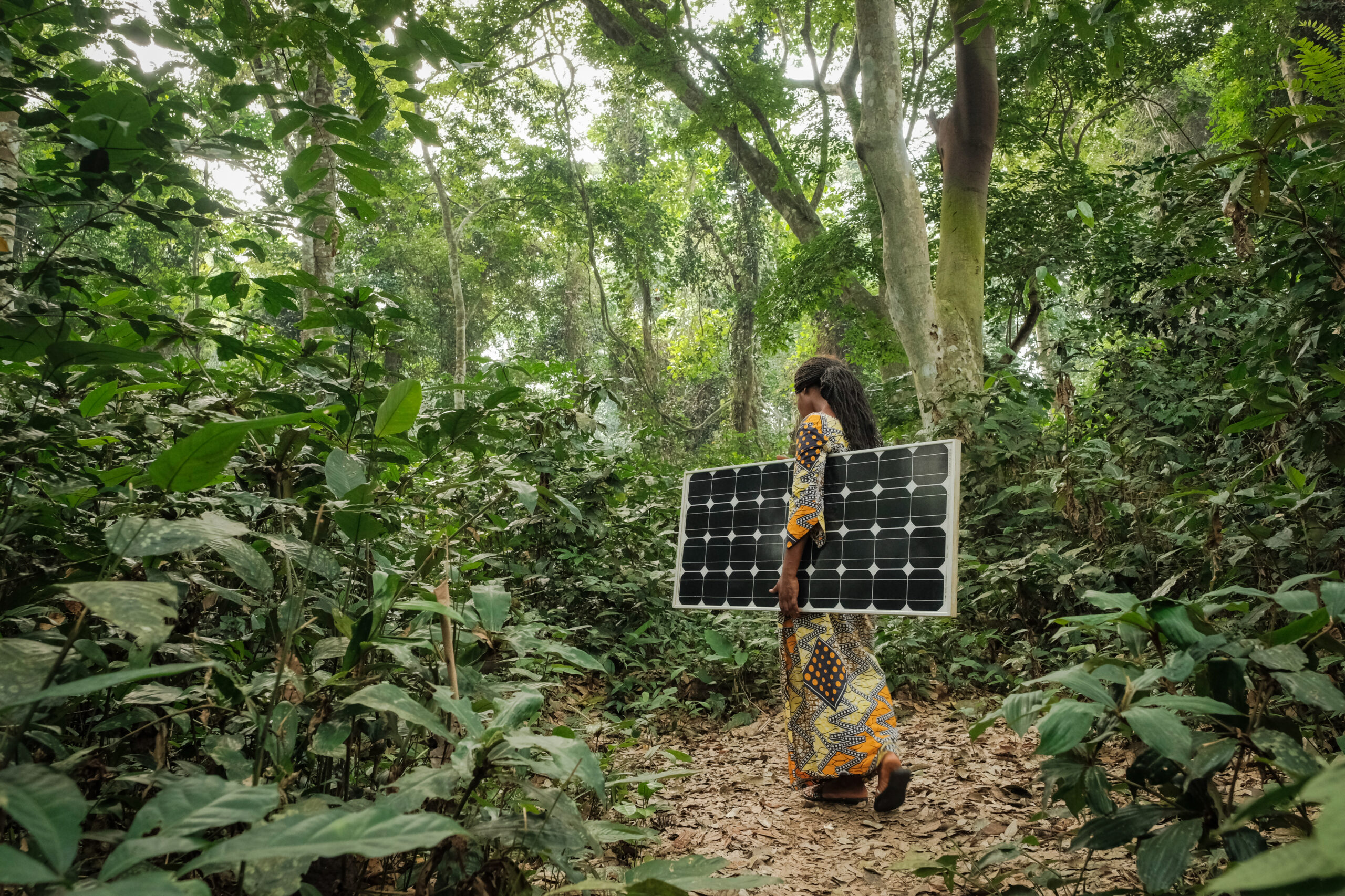
Woman carrying a solar pannel near Yangambi, DRC. Photo by Axel Fassio/CIFOR via Flickr under licence CC BY-NC-ND 2.0. https://flic.kr/p/27NYoQe
Gender-Responsive Renewable Energy for Empowerment and Inclusive Energy Transitions
Tuesday 10 November 2026
This side event, hosted by the International Centre for Integrated Mountain Development (ICIMOD) as part of COP31, will explore how gender-responsive renewable energy can strengthen women’s livelihoods, agency and economic opportunities, drawing on field experiences from regional and global evidence, policy and financing perspectives. This event is in-person only, and open to anyone attending the […]
Women working in their fields in GIE Kaout, a women- led agricultural cooperative in Senegal. The group of 32 women grow rice in order to develop the cultivation of other produce such as fruits and vegetables. Their plot is fenced and has a water tower with solar panels to run the pump. Credit: © JB Russell/Panos Pictures
From Clean Energy Transition to Just Energy Futures
18 November 2026
The major scientific and policy focus of the global clean energy transition has thus far been on issues of technological feasibility. Yet evidence from the Clean Energy for Development research initiative suggests that the greatest barriers to inclusive transition are often not technological, but financial, institutional, and social. Drawing on evidence from 12 projects across […]
Women working in their fields in GIE Kaout, a women- led agricultural cooperative in Senegal. The group of 32 women grow rice in order to develop the cultivation of other produce such as fruits and vegetables. Their plot is fenced and has a water tower with solar panels to run the pump. Credit: © JB Russell/Panos Pictures
Beyond COP31: putting people at the heart of the clean energy transition
19 November 2026
As COP31 draws to a close, new evidence from across 27 countries shows that the biggest barriers to an inclusive clean energy transition are often not technological, but financial, institutional and social. As attention shifts from negotiation to delivery, a new research synthesis report ‘From Clean Energy Transition to Just Energy Futures’ offers a practical […]